
Technology +
How It Works
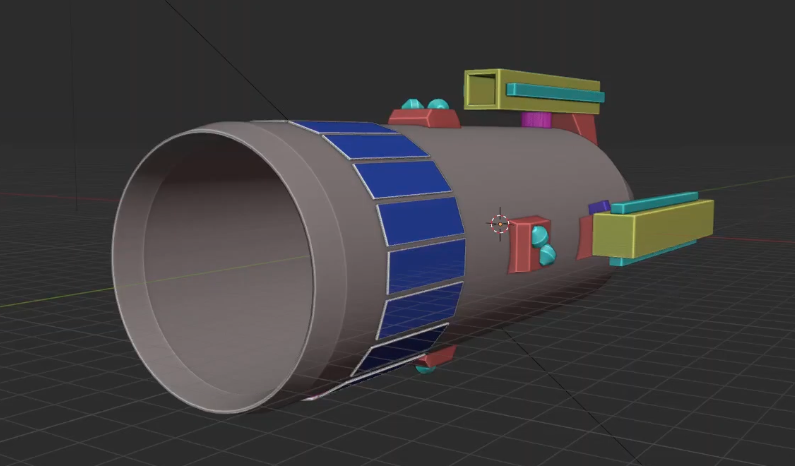
SWEEP combines advanced algorithms, debris processing, electromagnetic propulsion, and gyroscopic control to autonomously capture and eject space debris.
Algorithm
The algorithm uses an autonomous decision-making loop to control all of SWEEP's operations and guide it while chasing down debris. The initial iteration of the algorithm maps out a specific debris target and intercept the debris. Afterwards, the algorithm selects which railgun to use to reorient the tunnel in a specific way in preparation for catching the next debris. This process continues until SWEEP detects no more debris or the instance operation is ended.
Debris Processing
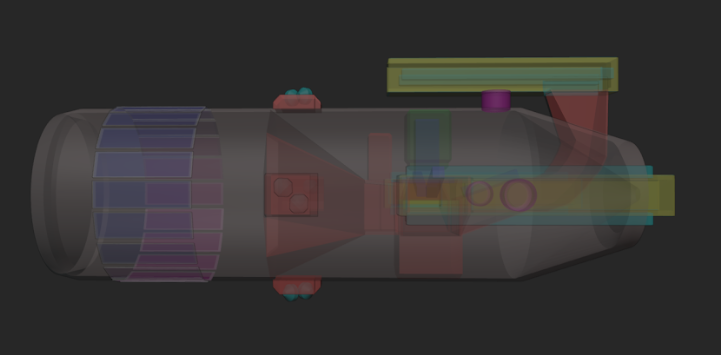
After being captured, debris is encapsulated in a conductive medium. It is then transported to a compression chamber which will compact it into dense pellets.
Propulsion & Disposal
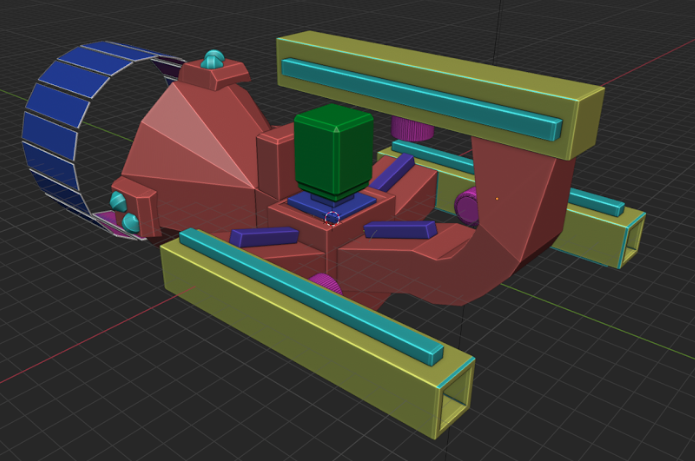
These pellets will then be fired from one of three railguns toward deep space in an angle that propels the tunnel, usually directly tangential to the tunnel's path. The railgun will use electromagnetic acceleration to quickly release the debris and remove it from Earth's orbit. This recoil will in turn generate thrust to maneuver SWEEP.
Attitude Control
Control Moment Gyroscopes (CMGs) will be used to assist throughout SWEEP's operation in order to both correctly orient the tunnel when approaching new debris and realign it after releasing debris. The four CMGs will allow all three axes of rotation to be controlled for the tunnel and provide for stabilization without using fuel.
Advantages
of SWEEP
Cutting-edge solution designed to combat the problem of space debris.
Sustainable
SWEEP uses an array of solar panels to keep the system self-sustaining and requires minimal, if any, propellant beyond the initial launch. SWEEP also leverages conservation of momentum to reorient and maneuver as debris is released from the tunnel.
Efficient
SWEEP’s algorithm, powered by an advanced onboard computer, strategically decides which space debris to target. This allows space debris to be picked up systematically and optimizes fuel consumption according to debris trajectories.
Scalable
SWEEP features a design that is adaptable for various sizes of space debris. The capturing tunnel’s dimensions can be customized to meet the needs of our government and commercial partners.
Meet the Team
See the brains behind SWEEP and learn about our story here.

Aayan Ali
Senior
Dallas, TX, USA

Ansh Pathak
Junior
Dallas, TX, USA

Ansh Gandhi
Sophomore
Dallas, TX, USA

Jetrin Chusacultanachai
Sophomore
Bangkok, Thailand
Contact Us
Interested in SWEEP? Have any questions or concerns?
We'd love to hear from you.